

When communicating with many individual traders, we often hear a similar feeling: facing institutions with better funds, information, and tools, individual traders seem to be naturally at a disadvantage.
Therefore, many people will regard "catching up with institutions" as their goal, looking for more complex indicators, faster information channels, and even trying to copy the analysis methods of institutions.
But the problem is that what individual traders really need to solve is not necessarily "how to become like an institution."
Institutions and individual traders are already under different resource conditions. What is really worth thinking about is: What are the advantages of each party? Which areas should individual traders focus their energy on that are more suitable for them?
1. Information side: natural lag and noise are objective realities
The advantage of the organization is based on the efficiency of information acquisition: industrial research, first-hand orders, and macro research and judgment are all followed by dedicated teams, with short information links and less distortion.
Most of what individual traders are exposed to is public information that has been forwarded and interpreted twice at multiple levels.
The problem with this type of information is not only lag, but also the fact that subjective interpretation and emotional rendering are superimposed on the communication process, which is full of a lot of noise.
Relying on this type of information-heavy game is equivalent to using unreliable materials to make high-risk transactions.
This is an objective gap at the resource level, and it is difficult for ordinary traders to make up for it in the short term.

2. Analysis side: Homogeneous thinking makes it difficult to achieve excess returns
After obtaining public information, most traders will use similar analysis methods: refer to K-lines, moving averages, volume and price, and the market environment to make market judgments.
This framework has a low threshold, participants converge, and the final judgment is often highly consistent.
Homogeneous analysis can occasionally get the market right, but the income is highly dependent on the market environment and there is no stable advantage.
Once the market reverses, a large number of traders will become passive simultaneously.
Information competition for funds and channels, in-depth analysis competition for research teams, both are the home court of the organization.
Individual traders continue to invest in these two areas, and the input-output ratio is very low.
3. The real competitive point: decision-making, not prediction
Information and analysis determine what you can see; decision-making determines what you do when the market changes.
This is also where individual traders can polish and build their own advantages.
Many people confuse forecasting with decision-making:
Forecasting is to judge the future direction of the market; decision-making is to set action plans in advance for different market scenarios.
A complete decision-making framework only requires answering three questions:
The market is in line with expectations, how to hold positions and take profits;
The market breaks through the risk control boundary, how to leave the market;
If there is no qualified opportunity, why not wait with a short position?
The goal of decision-making is not to look in the right direction every time, but to make plans in advance and control the risk of a single transaction within a tolerable range.
At this point, individual traders have freedom that institutions do not.
Institutions are constrained by performance appraisals and product deadlines, and often need to maintain a certain trading frequency, making it difficult to short positions for a long time; individual traders do not have forced trading pressure and can wait patiently for high-odds opportunities. If the opportunity is not suitable, they choose to wait and see.
This option is an important advantage.
4. There are only three underlying logics for first-class decision-making
A mature decision-making system is not complicated. The core is three principles:
First, accept the probabilistic nature of transactions, and there is a possibility of loss in every order;
Second, set exit criteria in advance, strictly stop losses when judgment is wrong, and do not hold orders subjectively;
Third, after a single transaction is completed, it is not disturbed by a single profit or loss, and returns to the rules to wait for the next opportunity.
The focus of this system is to respond. There is no holy grail of stable profits in the market. The feasible path for individual traders is to establish rules to prevent big losses under information disadvantages and stick to them.
The rules cannot guarantee every profit, but they can prevent a big loss from swallowing up the previous gains.
As long as you retain your trading qualifications, you will have the opportunity to wait for high-quality opportunities and obtain long-term positive results with the help of probability.
5. Cognition is easy to understand, execution is the biggest threshold
It is not difficult to understand this logic, but what is difficult is to stick to the rules under the impact of profits and losses.
The anxiety caused by floating losses and the luck after continuous profits will quietly deform trading behaviors: delaying stop losses, enlarging positions, and opening positions frequently without signals.
There is a psychological threshold that is difficult to cross between recognition and implementation.
This is also the pain point that EagleTrader proprietary trading wants to solve.
It does not provide market signals or predict rise or fall, but provides a verification environment with fixed risk control constraints.
Traders can implement their own trading ideas here, hone their decision-making and execution habits, and do not have to directly bear the psychological pressure caused by principal losses during the training stage.
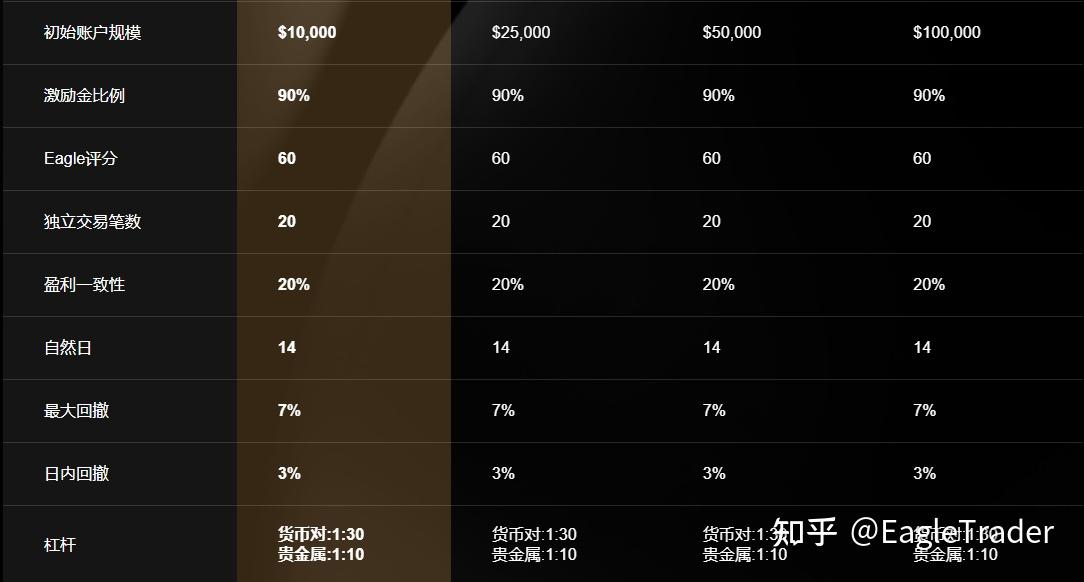
When a trader's ratings, effective trading samples, profit consistency and other indicators meet the standards, he can receive trading profit incentives.
The core of platform assessment is not the amount of single profit, but the long-term stable rule execution ability, which is what we call decision-making ability.
We don’t have to forcefully complement the institution’s resource advantages in information and research. This is not a track for individual traders.
Instead of chasing first-hand news and looking for magic indicators, it is better to focus on building a trading framework: from predicting the market to responding to the market, and establishing decision-making rules that can be reviewed and iterated.
The long-term success or failure of trading never depends on who sees it more accurately, but on who always maintains a stable standard of action in an uncertain market.
Contact
|
Leave a message online
|
Service hotline
852-53489575
 |

Incubate the world's top traders
Participate in 90% profit sharing