

Exclusive interview with Max profit-sharing trader: Why did he cut his position in half when he was only one step away from profit-sharing?
Launched for more than a month, EagleTrader
The Max model ushered in the first batch of profit-sharing traders! Faced with strict risk control that once seemed "somewhat difficult", the first batch of successful traders proved with results: Max rules are never meant to set limits, but to help traders get rid of those bad habits of doing things casually.
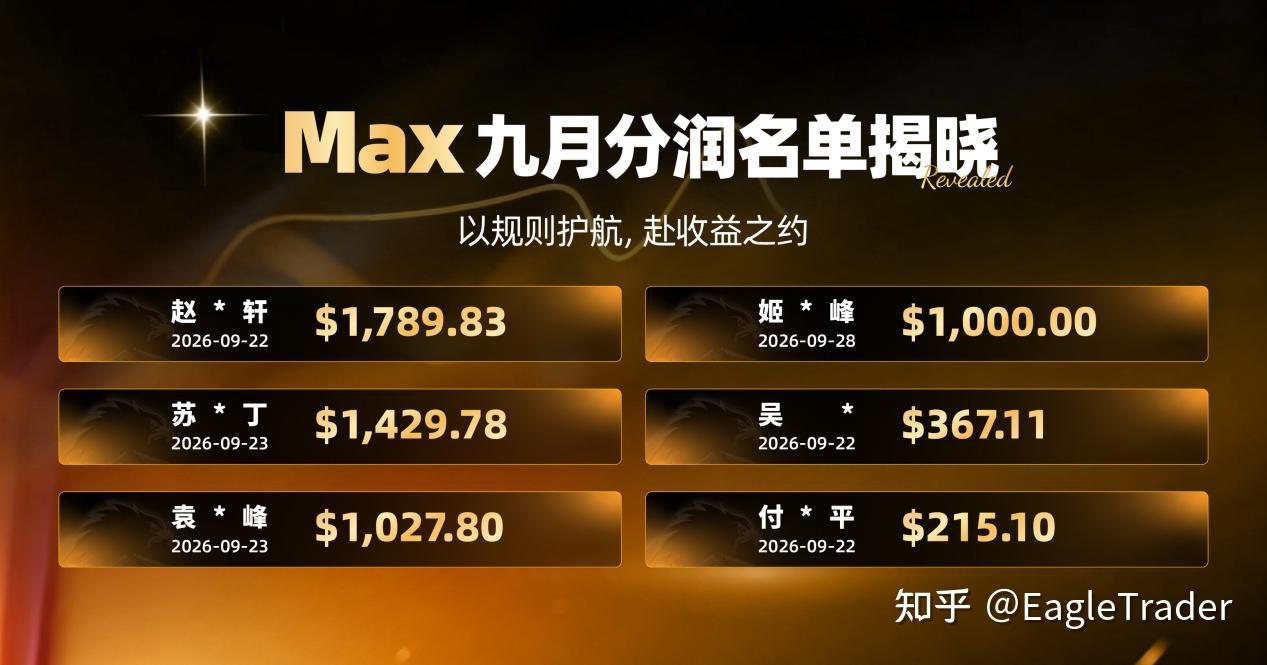
How difficult are these bad habits to break? Zhao Hanxuan, the first guest in the EagleTrader Max profit-sharing trader interview series, may have the most say.
Unlike many people's imagination of a "glamorous and successful trader", he frankly admitted that he is still losing money throughout his trading career.
However, it was while participating in Max mode that he did something he had never done in the past three years.
So how did such a trader who was still "on the road to recovery" successfully obtain a profit of $1789 under the rules of Max mode?
start of transaction
Zhao Hanxuan’s earliest exposure to trading was with ETFs.
After switching to internal futures in 2023, he has experienced almost all of the novice problems of chasing ups and downs and frequent trading - these are typical novice problems in retrospect.
Then he turned to external trading, and his losses further expanded.
During the interview, he did not shy away from his past.
He said that until now, if the entire trading career is calculated together, the cumulative result is still a loss, and the loss is about US$70,000.

One of the episodes that impressed him most occurred during the gold market last year.
From January to around Qingming Festival, he had been trying to go short against the trend.
But looking at it from a current perspective, gold was actually building momentum for a subsequent rise during that period, but at that time he had already become obsessed with the "top."
The market continued to rise, and he continued to add short positions.
In just a few months, he accumulated losses of approximately US$50,000, which accounted for a large part of the losses in his entire trading career.
The price of growth is liquidation
He still remembers a transaction before Qingming very clearly.
At that time, he still judged that the market would go down, but due to his excessive position, his account was blown up before dawn.
The location of the liquidation happened to be close to the high point of the day's market.
Just after he was forced to close his position and leave the market, gold began to fall as expected, and subsequently entered a unilateral trend of more than $100.
This is the most uncomfortable part: the market finally went according to his judgment, but the transaction still ended in failure.
The problem is no longer just the direction, but also the position and risk control, leaving him no chance to wait for his judgment to be realized.
He later summed up this experience into a simple truth: learn to wait.
In the past, when I first started trading, I wanted to leave the market as soon as there was a profit of 1-3 points, and I rarely really held on to a market trend that exceeded 10 points.
Although I still focus on day trading now, I pay more attention to the profit and loss ratio, and usually deal with transactions based on the idea of about 1:2.
Position management also became a red line that he was particularly wary of.
He mentioned in the interview that the liquidation made him realize that even if the direction is finally correct, if the risk is exposed to a level that he cannot bear, the result will still be a loss of all principal.
So later on, he often reminded himself: Don’t do things beyond your capabilities.
Start planning again
Zhao Hanxuan actually participated in other modes of EagleTrader once before, but failed.
When he went back to review the trading, he attributed the failure to the following: increasing the position with a floating loss and not trading according to the plan.
So, before entering Max this time, he first set a new process for himself:
Before the market opens every day, write down the market analysis of the previous day and the market outlook for the day;
Plan in advance the long and short positions and trading strategies that you may focus on that day;
After the market closes, write a review report to clearly record why each order entered and exited the market.
He said that this time, he basically relied on this set of disciplines to implement it, and finally got a profit share.
Of course, there are times when things get out of control during the process.
After making profits for two consecutive days, one day he "got lazy" and did not make a serious plan. Then his account experienced a significant retracement, with the maximum amplitude exceeding 2%.
But this time, he didn't stay in the plate like he did in the past.
After decisively stopping the loss and closing the position, he chose to stay away from the screen for four or five hours, calm down again, organize and analyze the market, and then decide on the next operation.
Close to the target, but reduce the position
When the transaction reached a profit of about 5.5%, Zhao Hanxuan said that his psychological pressure began to increase significantly.
At that time, the first profit sharing target of 6% was already within striking distance.If we look at it in the past, this would have been the most dangerous moment when people would easily get carried away and want to "try again."
But he made the exact opposite choice.
He originally traded at 0.2 lots, but when he was about to reach the target, he took the initiative to halve his position to 0.1 lots.
After that, he carefully maintained smaller positions until he successfully crossed the 6% threshold.
The moment his goal was achieved, he immediately stopped trading and did not place any more orders.
This almost "conservative" choice reflects his rebirth after experiencing big losses: the closer the profit is to the end, he no longer thinks about "how much more he can make", but how to firmly protect the fruits he has obtained.
The hardest thing to control is yourself
When talking about what is the most difficult thing to control in trading, he almost said "the market" at first, but then immediately changed his mind: "It must be you." Because the market itself is not right or wrong, the only thing traders can do is to adjust their behavior according to market changes.
The easiest time for him to lose discipline is often after his first two transactions have been stopped.
Especially when the market price rises sharply in the original direction as soon as the loss is stopped, the reluctance of "Why did you hit me first when you were right just now?" will emerge, tempting people to rush in for revenge trading immediately.
Zhao Hanxuan calls this state FOMO (fear of missing out), which is an emotion he still deliberately controls today.
For this reason, he set an iron rule for himself: if there are more than three stop losses on the day, he will resolutely stop opening positions.
No matter how the market rises or falls later, it has nothing to do with you.
What should you do if you really can't control it? His answer is more direct: "Shut down." Use physical means to cut off the possibility of continuing transactions.
“Everyone always talks about ‘overcoming human nature’, but human nature itself is actually difficult to truly overcome.
At the end of the transaction, you will not only face the market, but also your own personality and weaknesses."
Discipline over results
After a year of hard work, Zhao Hanxuan has a relatively fixed trading system. The main changes are in the take-profit processing, while the stop-loss principle is unshakable.
Compared with three years ago, he has another very interesting change: he talks less.
In the past, before the market trend came out, he liked to share his judgment with his friends in advance; if he was right, he would also enjoy the praise of others.
But over time, he found that this overexpression would make him blindly optimistic, which would affect execution.
Now, he prefers to let the market play out first and see the results later.
When we asked him, “What is most important when judging whether a transaction is done well or not?”, his answer was only one word: discipline.
"Even if it ends up being a loss, as long as the whole process is within plan, it's a good deal."
The first Max profit sharing
Talking about the reasons for choosing EagleTrader Max, Zhao Hanxuan said that the reason is very simple: the profit distribution time is faster and the overall cost-effectiveness is also high.
But after he actually got the profit, what he valued was not the profit itself, but the result's affirmation of his trading system, and it was also a "reward" for his strict discipline during this period.
After receiving his profit share, what he most wanted to continue improving on was discipline.
Because he knows very well that it is impossible for him to completely avoid making mistakes. What he can do is to make fewer and fewer mistakes that he knows should not happen.
At the end of the interview, we asked him to leave a piece of advice for new traders.
He said, “Before you prepare to place an order, don’t think about how much money you can make, but assume that your judgment is wrong.
If this transaction ends with a loss, can you accept the loss? If you can accept it, try again; if you can't accept it, give up immediately."
Getting the first profit share from EagleTrader Max is just a comma for Zhao Hanxuan.
Watching him go from blindly chasing highs and trading frequently to now fearing risks and executing according to plan, we see not only the failure of a trader, but also the epitome of countless ordinary people who have struggled in the market and finally chose to reconcile with themselves.
The road to trading is still long, but this time, Zhao Hanxuan has an extra pass called "discipline" in his hand.
And this is just the beginning!
Contact
|
Leave a message online
|
Service hotline
852-53489575
 |

Incubate the world's top traders
Participate in 90% profit sharing