

The most dangerous moments in trading are often not the loss itself, but those moments when you feel that you are "in good shape".
Many people mistakenly believe that mature traders have no emotions at all.
But in 2026 "Modern"
Finance" research gives a different conclusion: Even for traders with a rational analysis style, emotions still occupy a core position in decision-making. Therefore, the difference between transactions is not to eliminate emotions, but to identify them in time.
However, the most terrifying impact of emotions is not when they are out of control, but when they are disguised as "rational judgment".
Check out the following four “top” moments to see if you’ve ever fallen victim to them.
1. After losing money, I can’t wait to “make it back”
A transaction was stopped and the net value of the account retraced.
You stare at the screen, fingers hovering over the keyboard—not picking up new signals, but replaying the loss over and over in your mind.
This is where revenge trading begins.
It is driven by frustration and reluctance, essentially a desire to recover losses quickly through risky trades.
Recency bias magnifies the weight of this loss, making a single loss outweigh the statistical results of dozens of previous trades.
Retaliatory trading transforms this cognitive imbalance into operations: if you enter the market in a hurry again, the position will often be larger, the stop loss will be more hasty, and it will be easier for the market to directly wipe out the loss.
Relevant research describes this cycle like this: Every time you open a position emotionally, it will create a self-rationalizing "evidence" for your brain, making you feel that the next transaction has more reasons to correct the loss.
Accounts are shrinking, but emotional costs are rising.
2. After winning several games in a row, I feel that I “understand the market.”
Few traders have discovered the risks hidden behind continuous profits.
Most people know that losses will interfere with their judgment, but they often ignore the changes in mentality brought about by continuous profits.
A series of profits will give rise to the illusion that one's understanding of the market has become more transparent.
What followed was an enlargement of positions, an increase in frequency, and a relaxation of entry conditions, making the original risk limits look "too conservative."
But this shift will not come in the form of "I am overconfident now", but will be disguised as reasonable self-perception: "I am really good today" "This opportunity is particularly clear".
Continuous profits may come from high-quality execution, or it may just be that the short-term market just fits your direction.
The former can be copied, the latter cannot.
3. Seeing that others are making money while you are short
You originally made a clear plan and were not going to open a position that day.
But seeing other people's profit screenshots, or seeing a certain variety rising rapidly, but you are not included in it, will make you itchy.
What drives you is not exactly greed, but something more primitive: the anxiety of missing out.
The definition of FOMO in trading is very specific: it is not based on objective signals, but the impulse to open a position simply due to the fear of missing out on the market.
Social comparison plays a key role in this - multiple psychological experiments have confirmed that the anxiety caused by witnessing others' gains is sometimes more unbearable than suffering one's own losses.
The most difficult thing to guard against FOMO is that it can make you mistakenly think that you are seizing opportunities, but in fact you are just chasing a market that has already gone through a long period of time.
4. Everything went smoothly that day, so I made two more transactions in the afternoon.
All the transactions were cashed out in several consecutive transactions in the morning, and the account has accumulated a good floating profit.
In the afternoon, I saw another opportunity that was “almost possible to participate.”
The signal that originally required confirmation of two or three conditions before entering the market is now relaxed to "almost enough";
I had already completed my plan for the day, but a thought came to my mind: I was in good condition and could make two more transactions.
What often changes is not the strategy, but the trading frequency.
This change is difficult to detect at the moment, and the account is even still profitable, but a core problem is exposed behind it: using the results in the morning to provide psychological endorsement for the new risks in the afternoon.
The profits earned in the morning are regarded as risk chips in the mental account that can be squandered at will.
These four "tops" have a common solution
Revenge trading, overconfidence after profits, FOMO, and blindly increasing frequency when the market goes well—the four states have completely different external manifestations, but the underlying logic is highly consistent: use recent trading results to replace the objective calculation of current risks.
Each time, you're using "what just happened" to determine "what to do next."
But from a probability perspective, there is no direct relationship between the recent results and whether or how big the next transaction should be.
Since the problem lies in the "recent results" interfering with judgment, the solution is clear: remove the recent results from the decision-making chain.
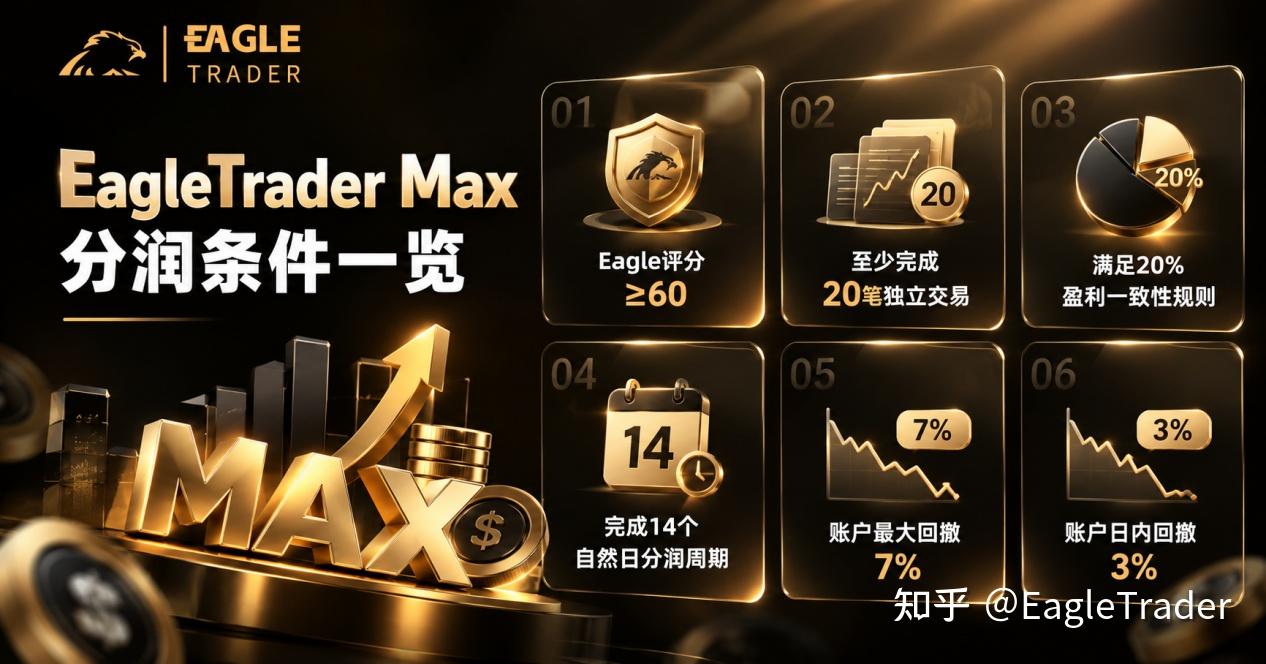
The rule system of EagleTrader Max does exactly this.
The 7% total retracement anchors the highest water level in history. No matter you just lost a sum or won several times in a row, the risk control line only follows the account peak;
The 3% intraday retracement anchors the highest water level of the day. No matter how much you make in the morning, your risk budget in the afternoon will not be expanded;
The profit consistency rule checks whether profits are evenly distributed across multiple trades, not the highlights of a given day.
It does not judge for you "whether you should do this order or not." It only tells you one fact: how much risk space you have left from the peak of your account.
This space will not become larger because you "want to get it back", nor will it become larger because you are "in good shape".
It is only related to the trend of the account itself.
Of course, rules can constrain behavior, but they cannot eliminate impulses at their source.Risk control is the last line of external defense, and the first barrier to truly resist emotional trading always comes from the trader's own emotional awareness.
But if you find yourself making repeated mistakes in the four "top" moments, then a risk control red line can at least give you one more reason to stop when you are impulsive.
Contact
|
Leave a message online
|
Service hotline
852-53489575
 |

Incubate the world's top traders
Participate in 90% profit sharing