

When transactions go well, people tend to let their guard down.This kind of relaxation is often not immediately reflected in profits and losses, but it will slowly change the risk structure of the account.

EagleTrader
Max's dynamic high-water retracement rule is precisely to make this "hidden change in smooth times" visible - because the retracement boundary will be adjusted with the new high of the account, traders cannot rely on "feeling" to judge whether their risk is out of control.
Behind this mechanism is a very simple observation: when trading does not go well, people will automatically tighten their risks.
Continuous stop losses will reduce positions, those who do not understand the market will be less likely to enter the market, and account withdrawals will prompt traders to go back and check their transactions.On the contrary, when things go smoothly, some problems are easier to let go.
The most typical change usually starts from the position.
After profits are made, positions tend to expand.
Continuous profits bring confidence.Originally, a transaction carried a fixed risk, but after a few successful trades, it was easy to feel that the account had a profit bottom line, so it increased the position, relaxed the risk, and even accepted some opportunities that it would not have taken in the past.
Accounts are still growing, but the risk structure has changed.
This change is almost invisible during the rise. Only when the retracement occurs, you will find that the retracement is not calculated from the principal, but from the peak after the rise.
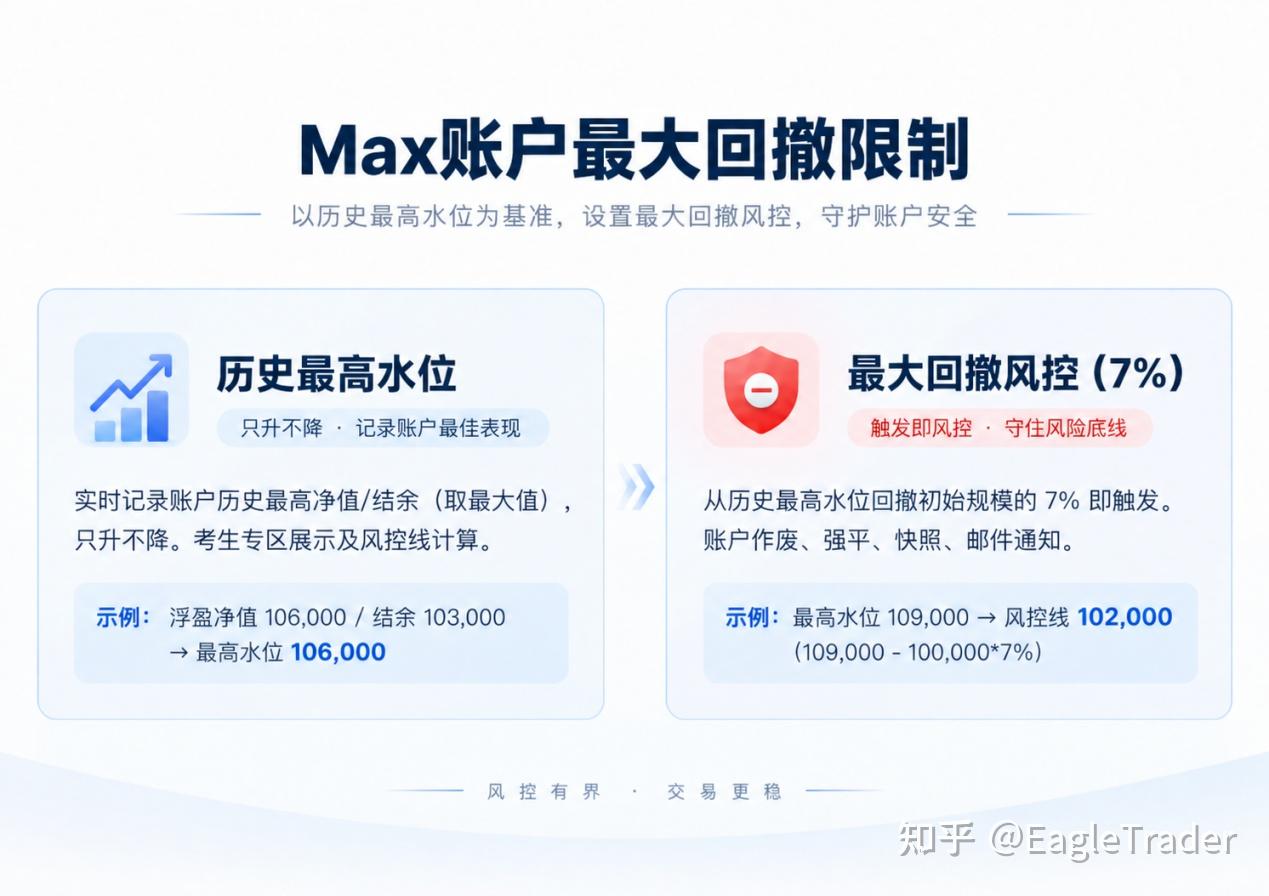
The 7% maximum retracement limit of the EagleTrader Max model is anchored at the historical highest water level of the account. The higher the account goes, the retracement line will also move upward.
This means that every subsequent transaction is always managed based on the results that have been obtained, rather than with the mentality of "it is the profit earned anyway".
If there is a fixed logic in position management, the account profit will not change the single risk; if the risk exposure continues to increase with the profit, once the market turns, the advantages accumulated earlier will be eaten up faster.
If a day goes too smoothly, the trading frequency can easily get out of control.
Another change occurs within a single trading day.
In the morning, several transactions went smoothly, and the account had already made good profits. In the afternoon, when I looked at the new market conditions, people were more likely to be more positive than usual.
The opportunity that originally had to wait for several conditions to be confirmed has turned into "almost possible"; the original plan for the day has been completed, and I feel that I am in good condition, so I can make two more transactions.
What changes is generally not the strategy, but the trading frequency.
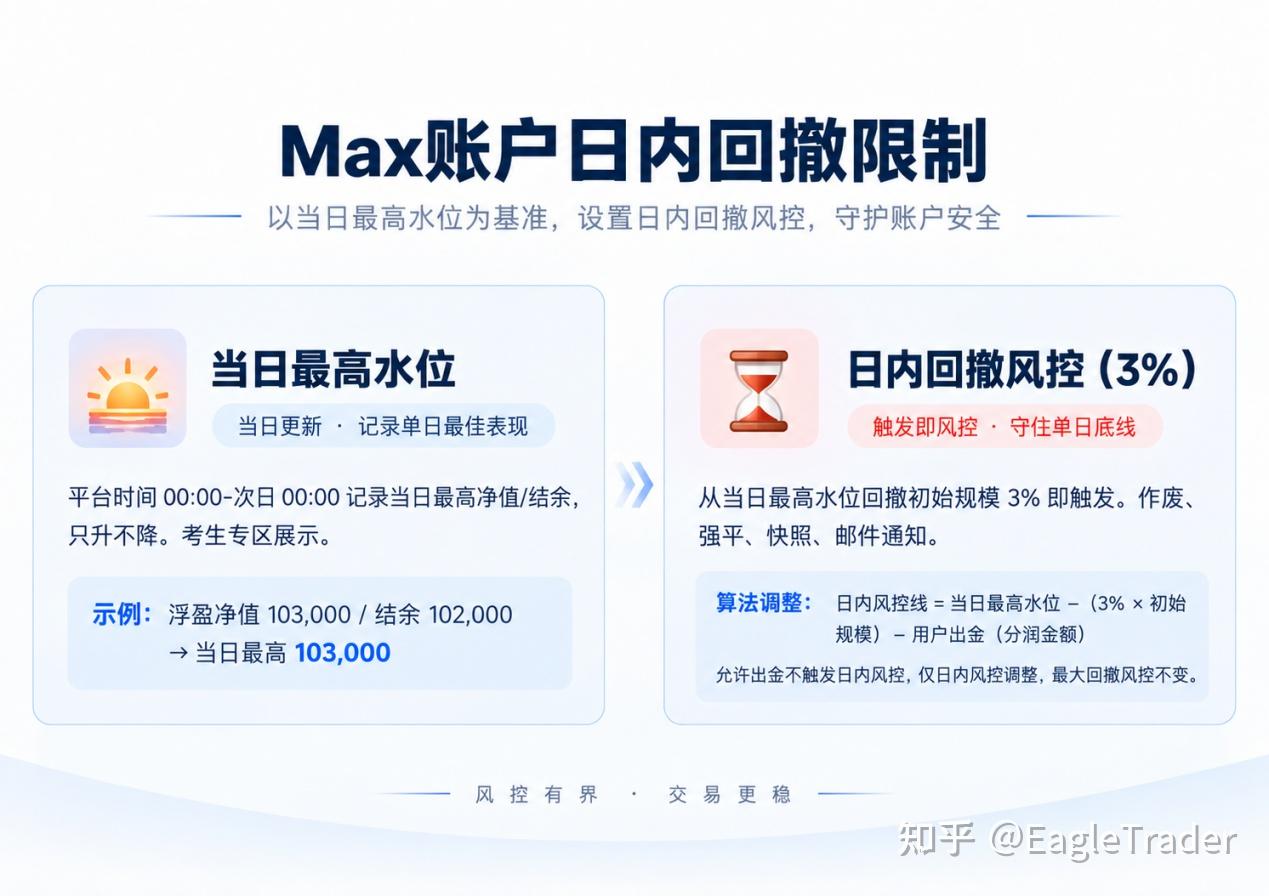
EagleTrader Max's 3% intraday maximum drawdown limit is also dynamically calculated based on the highest water level of the day. The account hit a new high that day, and the intraday risk control benchmark moved up simultaneously.
Therefore, the money earned in the morning will not automatically become room for increased risk in the afternoon, because the intraday retracement line focuses on the high point of the day, not the principal at the opening.
What this rule really targets is whether traders have their own daily risk budget and trading rhythm.
Favorable market trends will temporarily cover up strategic issues
There is another situation that is easier to overlook than position and frequency.In a market environment that is particularly suitable for a set of strategies, many problems will be covered up by profits.
If the trend strategy encounters a sustained unilateral move, and if the high-volatility strategy encounters a big market, even if the retracement is large and the parameters are aggressive, the short-term results may be very good.
A period of beautiful profits cannot explain the performance of a strategy in different market environments.
EagleTrader Max's two sets of dynamic risk controls are put together, one manages the maximum drawdown of the entire account cycle, and the other manages the risk fluctuations of a single trading day.
They do not judge whether the strategy is good or bad, but they will force several questions:
The market rhythm has changed, will the single-day fluctuations suddenly amplify?
After several consecutive unfavorable transactions, is the overall retracement still controllable?
After the account reaches a new high, the original position parameters are still applicable.
Having clear answers to these questions shows that a trading system not only thinks about "how to make money", but also thinks about "what to do when the market does not cooperate".
Continuous profits are of course a good thing, but it will also gradually magnify problems that are not usually obvious.
Whether the position has expanded with profits, whether the trading frequency has increased because of good conditions, and whether the current performance is that the strategy itself is stable or the market is just right - these problems are not easy to see when things are going well, but they have been changing the risk structure of the account.
EagleTrader Max's 7% maximum retracement and 3% intraday maximum retracement put this change within a clear boundary.
The retracement line follows the new high of the account. What you manage is always the results you have already obtained, rather than relying on your feelings to judge whether the risk is out of control.
For traders who already have mature strategies and are confident in their risk management, EagleTrader
The more direct aspect of Max is that there is no need for multiple rounds of profit target assessments. After entering the account, the strategy and risk control capabilities will be directly reflected in the account performance.
When the transaction goes well, it is easier to choose a mode that allows the risk boundary to follow the account than to review the transaction afterwards.
Contact
|
Leave a message online
|
Service hotline
852-53489575
 |

Incubate the world's top traders
Participate in 90% profit sharing