

Trading in recent years has indeed become increasingly difficult.
The Federal Reserve’s interest rate path has always affected market sentiment, and traders need to constantly judge how subsequent policies will be implemented; whether geopolitical conflicts have eased and whether risk sentiment will re-heat, which may also change market trends in a short period of time.
Coupled with the emergence of factors such as inflation, employment, and economic data, some relatively familiar trading logic in the past may not be able to be copied in the current market.
The market is becoming more and more complex, and traders are facing more and more choices.
But the real headache may not be that "this market is not easy to trade", but that the market has been going on for so long and I have experienced a lot of losses, but my trading skills have not improved significantly.
You will still step on the pitfalls that should be stepped on, and you will still make the mistakes that should be made.
One loss was attributed to the market trend, and the next time a similar situation was encountered, the operation was repeated; strategies were changed one after another, but a trading method that was truly suitable for oneself was never formed.
If you just keep losing money in trading but do not gain from the losses, then no matter how long you trade, you will only lose your wallet.
1. After trading for a long time, why has the technology not improved?
Trading is a process that requires constant trial and error and summary, but if you just continue to experience losses, you may not be able to improve your trading ability.
The most common problem is that there is no real review after a loss.
When a transaction loses money, the first thing many people think of is why the market suddenly reversed and why the news was not predicted in advance, but they rarely carefully analyze their own operations.
Why did you enter this trade? What was the basis at that time?
Is the stop loss reasonable?
Is the position beyond your tolerance?
If you do it again, will you open a position at the same position?
These problems have not been recorded and analyzed. Next time you encounter a similar market, it will be easy to repeat the previous operations.
So, loss itself does not automatically turn into experience.
Only when the loss is broken down and the parts that can be corrected are found, the transaction will truly leave something behind.
Another practical problem is that the cost of trial and error is too high.
If you want to improve your trading skills, you have to test strategies, adjust positions, and verify trading logic.
But every attempt in a real offer may directly correspond to a capital cost.
If a strategy fails to work, you will lose once;
Change a trading method and lose again;
If you want to test a more aggressive position, the retracement may expand further.
As time goes by, it is easy for your trading experience to increase, but your account balance does not increase, and there are not many trading methods that can really be settled.
Long trading time and frequent losses do not mean that trading ability will naturally improve.
The real problem is that many traders lack an environment in which they can repeatedly review, verify and adjust their trading methods.
So, is there a way for traders to truly verify their trading methods repeatedly while taking on lower financial risks?
Second, trading ability is not seen, but practiced
If you want low-risk transactions, many people will think of simulated trading, but ordinary simulated trading can easily become a "costless game."
If you lose money, you can reopen it, your position can be adjusted at will, and you don’t have to bear too many consequences if your strategy is wrong.
Such an environment can help traders become familiar with the market, but it is difficult to completely test their trading methods.
The difference between proprietary trading, another form of simulated trading, is that it adds a clear set of rules to simulated trading.
Traders need to conduct transactions within the prescribed risk range, comply with the trading requirements of the account, and are responsible for their own trading results.
In this way, the significance of the demo account is not just to familiarize yourself with the market, but to provide traders with a binding, challenging environment that can be practiced, verified and adjusted repeatedly.
Whether the strategy can be implemented, whether the position is reasonable, and whether it can continue as before after continuous losses.For planned transactions, these problems will be exposed in each transaction.
For traders who have not yet formed a stable trading system, this kind of training can reduce the pressure of repeated trial and error with real funds and make it easier to discover their own problems.
The real value of proprietary trading is that it can further tell traders: What exactly are you doing poorly?
3. Let every transaction become a feedback on ability
A complete proprietary trading system first needs to draw risk boundaries for traders.
Rules such as maximum loss and intraday loss will allow traders to think in advance how much risk they can take, and reduce the situation of constantly adding positions and taking orders because of a single misjudgment.
The second is the trading rules.
Rules give traders a clear reference for their operations.
Whether the position is reasonable, whether the transaction is stable, and whether it is executed according to your own strategy can all be continuously verified through actual transaction results.
There is another part that is easily overlooked, which is the systematic evaluation of trading performance.
Many traders know that they have lost money, but they don’t know where they are wrong.
It may be that the trading ability is insufficient, or the risk control is not done well; there may be no problem with the strategy itself, but the trading consistency is not enough; it may also be that the trading experience is insufficient.
It is difficult to distinguish these problems by just looking at the profit and loss of the account.
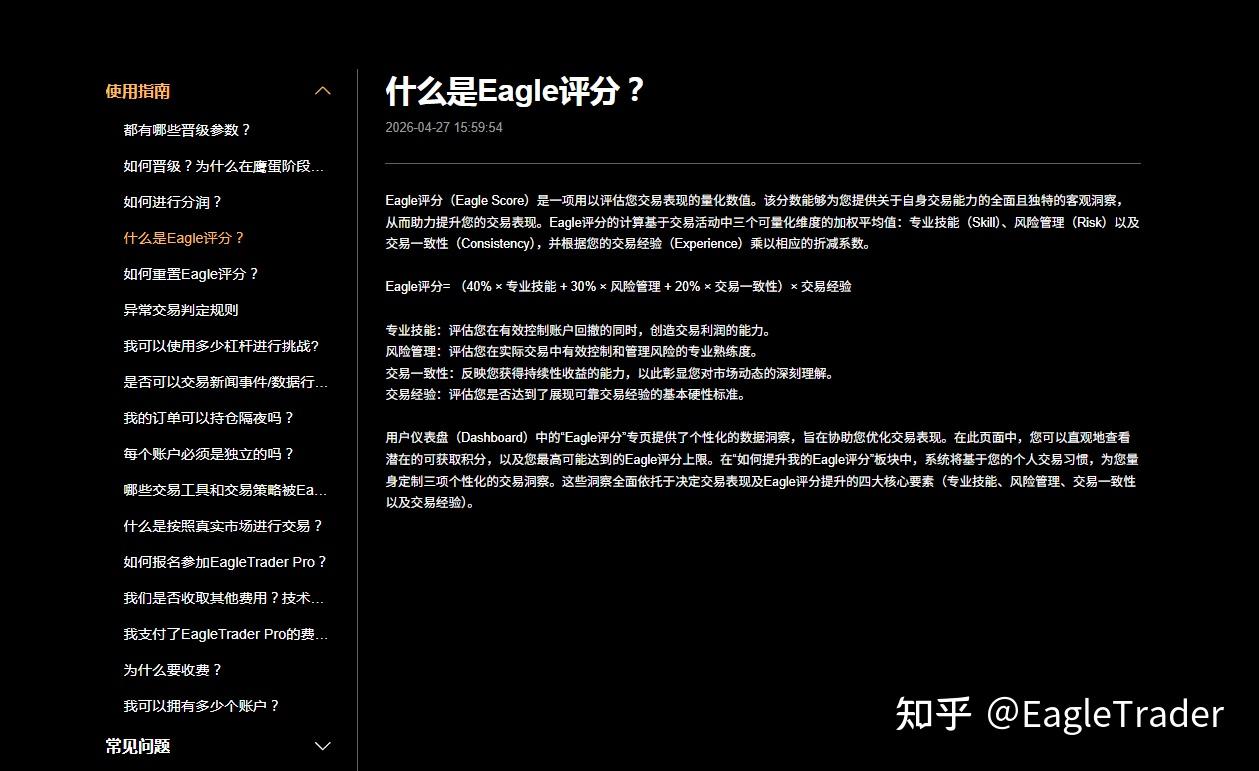
If trading performance can be evaluated from multiple dimensions such as trading ability, risk control, consistency and trading experience, traders will not only see "how much they made and how much they lost", but also be able to further understand their own trading habits and ability shortcomings.
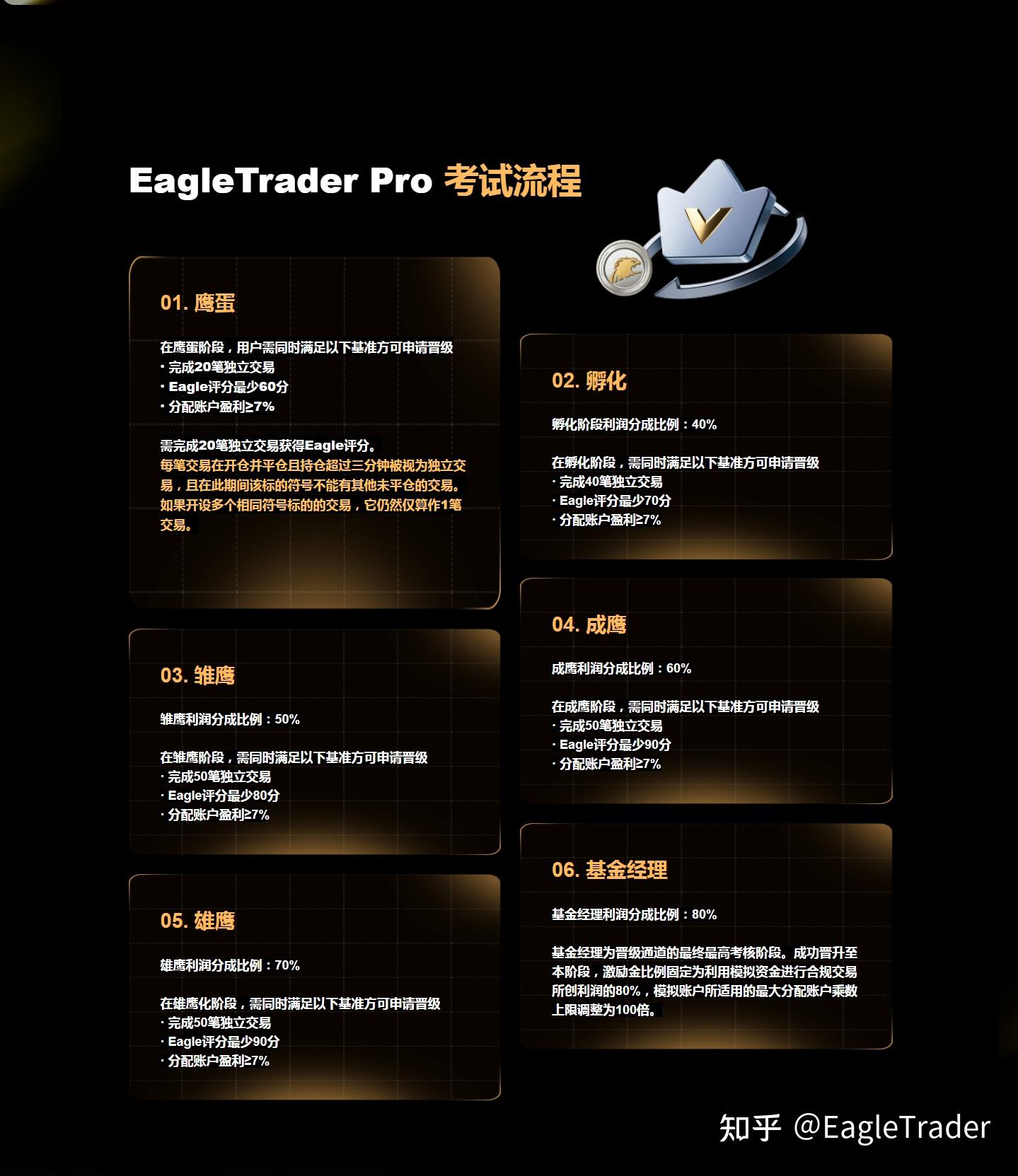
Take the domestic self-operated platform EagleTrader as an example. The platform comprehensively evaluates traders’ trading performance through mechanisms such as assessment rules and Eagle scoring.
Traders can verify their strategies during the assessment process, and can also find the direction that needs adjustment based on staged performance.
After completing the corresponding assessment and meeting the profit sharing conditions, traders can also obtain profit sharing from real funds in accordance with the rules.
So, what is really worthy of attention in proprietary trading is not just how much profit the account can make, but more importantly, it provides traders with a set of trading, feedback, adjustment, and re-verification processes.
Whether the market is good or not is always beyond the control of traders.
What you can control is your trading method when facing the market.
IfIf you have been trading for a long time and experienced a lot of losses, but you still can't figure out what went wrong with you, then the next step that needs to be changed may not be to find the next "more accurate" strategy, but to add a training method to your trading that can truly feedback the problem.
Let every transaction leave feedback and make every loss valuable.
What increases trading time should not only be experience, but also ability.
Contact
|
Leave a message online
|
Service hotline
852-53489575
 |

Incubate the world's top traders
Participate in 90% profit sharing