

In trading, determining how much risk to take on each trade is one of the most important tasks for a trader. We are always struggling between two goals: on the one hand, we hope to maximize profits through larger positions; on the other hand, we must minimize losses through professionally set stop losses.
Especially for traders who adopt trend following strategies or trade high/previous low breakthroughs, they often face a problem: the distance between the entry point and the technical stop loss level is often far.
Because many traders pay more attention to potential profits and ignore potential losses, they often fall into a misunderstanding in practice-in order to establish a larger position, they usually force the stop loss to be set too close to the entry point, placing it in a technically unreasonable position.
At the same time, there is also a common habit: just after the market moves in a favorable direction for a few points, the stop loss is immediately moved to the breakeven position, thinking that this is in exchange for "zero risk".
The results of these two behaviors often appear on the market very quickly: in normal market fluctuations, the price will make a correction to the previous trend, accurately hit the moved breakeven stop loss, and then disappear. The end result can be calmly summed up in one sentence: nothing is gained except trading losses.

When will "stop loss too tight" appear?
Let's look at a specific case. On this index (one-minute chart) we see a "triple top" pattern, which is confirmed as the lows are broken.
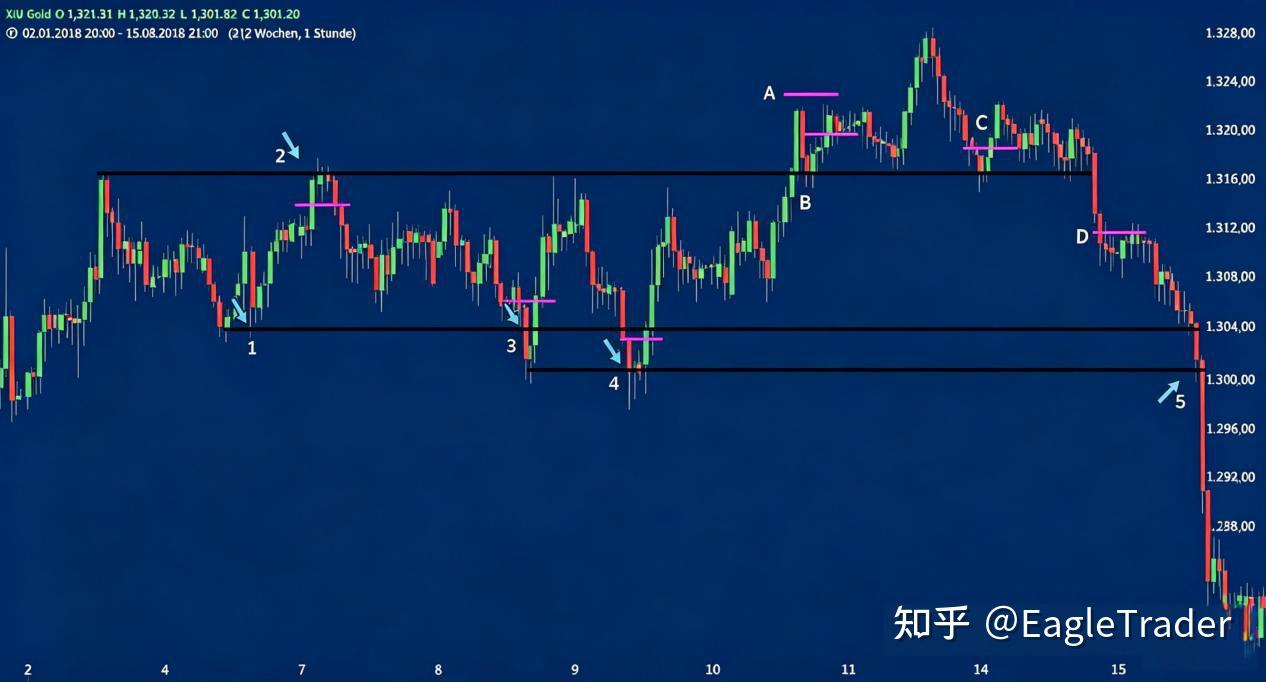
The trend is taking effect: The breakthrough K line in the figure clearly shows that the breakthrough has been established and the trend reversal is taking effect. For traders entering a short position here, a reasonable stop loss will usually be placed just above the triple top as price retests the breakout level as expected. Second entry: Subsequently, the price breaks downward again. This is the first real opportunity for trend following traders to enter (or increase their position) with the trend. The breakthrough of the K-line itself further strengthens this signal. Wrong fine-tuning: However, in order to obtain the so-called "perfect risk-benefit ratio" (or to enlarge the position with fixed risk), many traders are eager to tighten the stop loss and force the stop loss to the secondary position.High point. The result was naturally and inevitably happened: as the price pulled back, the tight stop loss was just swept away, and then the market continued to move downward unilaterally. The direction is right, but the execution is wrong. The profits that were reasonably expected turned out to be realized losses.
Why is this shortcoming infinitely magnified in a "self-operated environment"?
This habit of "stopping too tight" and "eager to protect capital" may only result in less profit and loss when trading with your own small capital. But in participating During professional assessments such as the EagleTrader (ET) proprietary trading exam, it often becomes a fatal reminder.
In the ET assessment, traders usually face two hidden psychological pressures: wanting to reach the profit target as soon as possible, and at the same time being extremely afraid of touching the red line of the maximum single-day retracement.
It is under this psychological suggestion that traders are more likely to compromise - using "extremely tight stop loss" to bet on "large positions being broken". But this just violates probability theory. Frequent unnecessary losses will not only eat away at your capital limit, but also directly destroy your trading mentality.
The rules of the self-operated examination are not intended to restrict you in essence, but are like a mirror that infinitely magnifies these execution loopholes that are not easily noticed at ordinary times.
Multi-point trading space
What is really worthy of discussion is not whether to stop loss, but where to place stop loss. If you set your stop loss too tight, you are actually actively "kicking yourself out" - and creating unnecessary losses yourself. The same problem applies to trailing stops.
Because the market usually experiences alternating fluctuations between "impulse market" and "callback market". During a pullback, it is completely normal for the price to come back closer to, or even briefly break through, the entry level.
If you want to pass the EagleTrader assessment, or steadily take away 80% of the continuous profit as a formal trader, here are two suggestions:
Start from technology, not from position: first find the point on the chart where the technical logic is overturned as the stop loss level. Then according to this distance and ET The prescribed daily risk limit can be used to deduce how many positions you should open today. Instead of setting a position first and then setting a tight stop loss.
Accept the market’s “wash” and two-way breathing: Be mentally prepared and accept the normal fluctuations of the market. The real purpose of stop loss is to protect you in the worst situation, not to let you end an otherwise successful transaction rashly because of fear of floating losses. Excellent technology needs to be matched with scientific execution, and it also needs an environment that can perfectly present technology. As a professional proprietary trading platform, EagleTrader We are always committed to providing global traders with a real-time simulation environment without the risk of capital losses, and to avoid traders' psychological problems such as deformation of transactions due to financial pressure to the greatest extent.
If you also want to verify whether your trading strategy is stable, you canto learn more about the Proprietary Trading Exam. Use your strength to unlock more trading capital and earn more opportunities in a less stressful environment.
Contact
|
Leave a message online
|
Service hotline
852-53489575
 |

Incubate the world's top traders
Participate in 90% profit sharing