

In the previous article, we took Eagle trader's "Fantasy Four-Dimensional Space Trend Band Strategy" signal source strategy as an example to dismantle the application logic of multi-time frame analysis in trend judgment and entry execution. This method can indeed help traders identify the market structure and direction more clearly.

But in actual trading, a more challenging question arises - when different time periods give inconsistent signals, how should trading decisions be made?
For example: the weekly trend is in an obvious downward trend, but the 1-hour chart continues to rebound; or the weekly trend is upward, but short-term signals frequently appear in short periods; even at some stages, the structure of each cycle loses directionality at the same time, which is neither a trend nor difficult to classify as a shock.
In this case, many traders will begin to frequently revise their judgments and switch back and forth between long and short, eventually leading to disordered execution and increased stop losses.
But from the perspective of a trading system, this type of "cyclical conflict" is not an exception, but the norm in market operation.
The structural nature of cyclical conflicts
From the perspective of market structure, there is no real "conflict" between multiple cycles, but differences in the performance of the same market at different levels. When the price runs a trend structure in a large cycle, reverse fluctuations will inevitably occur in small cycles.
Therefore, when a cyclical divergence occurs, it usually corresponds to three structural states:
First, the callback stage in the trend;
Second, the structural weakening at the end of the trend;
Third, a directionless shock range.
If these three states are not distinguished and trading decisions are made directly based on local signals, the problem of "each cycle has logic, but the whole cannot be executed" will easily occur.
Establishment of the main cycle
Among all methods of dealing with cycle conflicts, the most basic and important step is to establish the main cycle.
The role of the main cycle is not only to provide a reference, but also to serve as the final constraint for all trading decisions. That is to say:
The trading direction must be defined by the main cycle
Small cycles can only be used to optimize execution
Signals of any cycle must not overturn the conclusion of the main cycle
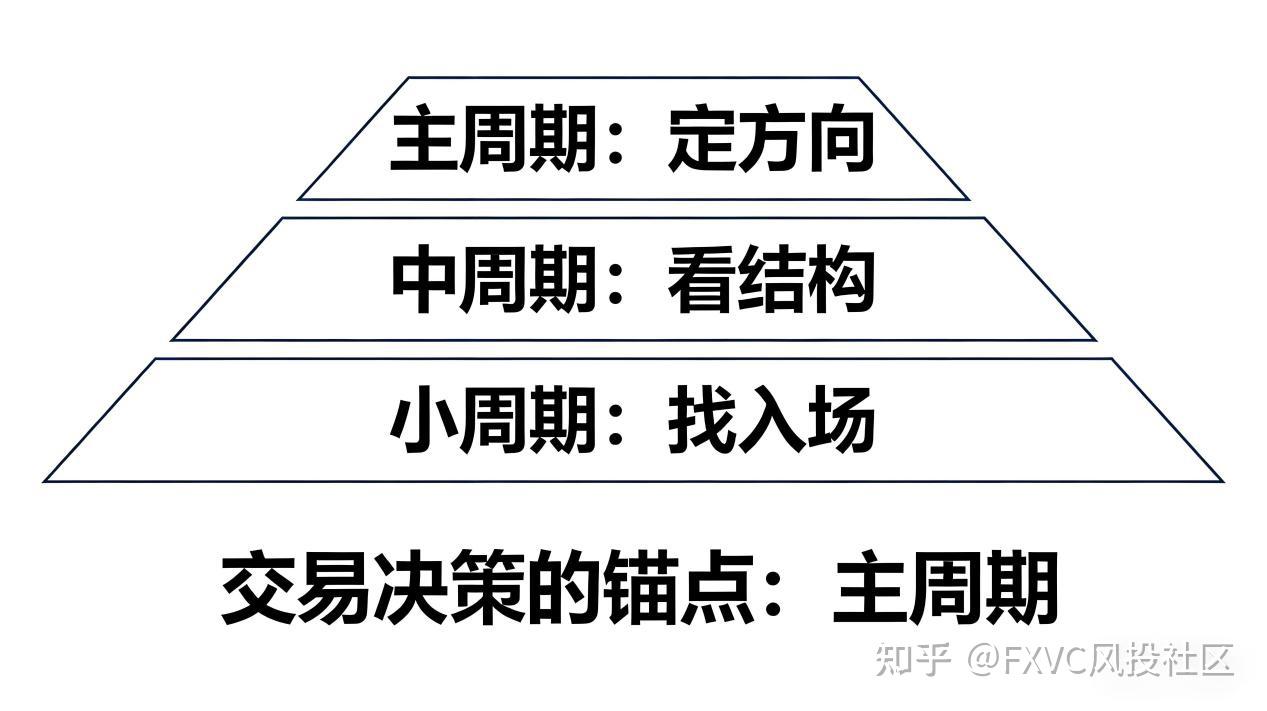
In the absence of a main cycle, traders tend to switch judgments back and forth between different cycles, ultimately leading to repeated trial and error in the same market. This problem is not a technical error, but caused by a lack of decision-making level.
Therefore, the determination of the main cycle is essentially establishing a stable "judgment anchor point" for the trading system.
Execution Principles of Conflict Handling
After the main cycle is clarified, multi-cycle conflicts will not disappear, but their nature will change - from "interference" to "opportunity".
The most practical processing principle is to split the functions of large cycles and small cycles: large cycles are used to define the direction, and small cycles are used to provide entry positions.
Under this framework, small-cycle reverse fluctuations are no longer regarded as a negation of the trend, but as a source of better entry ranges. For example, in the daily downward structure, the rise in a small cycle is usually a technical rebound, and its end position often corresponds to a more cost-effective short selling point.
This kind of execution logic of "following the general trend and going against the small trend" can effectively solve two common problems:
The first is to avoid chasing orders at the end of the trend; the second is to reduce passive stop loss during the callback stage.
From a long-term performance perspective, trading stability comes more from “position optimization” than from “directional prediction”.
Identification and response to ineffective markets
In addition to trends and callbacks, there is also a more destructive market state, which is the simultaneous loss of structural consistency in multiple cycles.
The typical characteristics include: lack of continuity in large cycles, repeated destruction of mid-cycle structures, and continuous oscillation and directionlessness in small cycles. In this type of environment, although price fluctuations occur frequently, there is a lack of sustainable trading logic support.
In this case, continuing to rely on multi-period analysis for trading will often lead to a significant increase in signal failure frequency and increase unnecessary transaction costs.
Therefore, from a system perspective, the response is not to optimize entry, but to reduce participation or directly short positions. The core of this decision is not to give up opportunities, but to screen the quality of the trading environment.
The true role of multi-period analysis
In practical applications, the value of multiple time frames is often misunderstood as "enhanced signal confirmation". But a more reasonable positioning should be to build a transaction filtering mechanism. A clearly structured execution process should have the following characteristics:
When the direction of the large cycle is unclear, the transaction is abandoned;
When the structure of the middle cycle is incomplete, no layout is carried out;
When the trigger signal does not appear in the small cycle, the entry is not executed.
In other words, the role of multi-cycle is not to increase trading opportunities, but to reduce the occurrence of low-quality transactions through layer-by-layer screening.
When this mechanism operates stably, trading behavior will gradually change from “actively looking for opportunities” toTransform into "passively waiting for conditions to be established" to improve overall decision-making consistency.
The divergence between cycles is a natural manifestation of the market structure, not an abnormal phenomenon. The maturity of a trading system does not lie in eliminating such differences, but in establishing rules to deal with them.
When the direction is unified by the main cycle, the entry is optimized by the small cycle, and the risk is controlled by the disciplinary boundary, trading behavior will have a stable foundation.
Truly effective multi-period analysis does not allow you to see more signals, but allows you to still make consistent decisions in complex environments.
If you are still looking for the rhythm of this kind of decision-making, you might as well take a look at what traders who have made stable profits do - in Eagle trader, the trading process of each signal source is a true representation of the multi-cycle strategy.
Contact
|
Leave a message online
|
Service hotline
852-53489575
 |

Incubate the world's top traders
Participate in 90% profit sharing